
Years on Morgantown Directory Shelves
Morgantown city directory research begins with an uneven set of holdings, not one continuous database. The West Virginia State Archives directory list identifies volumes that can be requested or consulted by year. The digitized 1901 book offers page images online, while the Morgantown Public Library, Aull Center, and WVU’s West Virginia and Regional History Center supply local reference help, books, databases, newspapers, and microfilm. A catalog hit confirms that a repository lists an item. It does not guarantee remote full-text access.
| Morgantown collection | Documented years or scope | Repository | How to use it |
|---|---|---|---|
| State Archives city directories | 1901; 1904-05; 1917-18; 1923-24; 1927-28; 1939-40; 1947; 1949-50; 1953; 1956-59; 1961; 1963; 1965; 1967-92; 1994-2002 | West Virginia State Archives | Finding list, then archive inquiry or visit |
| Digitized Morgantown directory | 1901, revised through April 8; 148 pages | Internet Archive copy linked by LDSGenealogy | Browse PDF or page images |
| Gale directory reels | 1914-1922/23 and 1922/23-1927/28; finding list notes gaps | Library-access microform collection | Confirm reel access with a library |
| WVRHC city directories | Call-number area 917.542-.5499 | WVU WVRHC | On-site books, computers, and reference help |
| Aull Center local history | Yearbooks, family histories, photographs, and local books | Morgantown Public Library | Visit or ask staff for a holdings check |
Visible gaps include 1902-03, 1906-16, 1919-22, 1925-26, and later single years. A blank in this list means the inspected Archives holdings are incomplete for that year. It does not prove that no Morgantown city directory was printed or that another library lacks a copy. Keep the repository, volume year, page number, and date of access with each note.
Inside Morgantown’s 1901 Directory
The 1901 volume is the clearest model of a Morgantown city directory. Tom B. Bowman prepared and revised it, and Acme Publishing Company printed and bound it in Morgantown. Its 148 pages include personal listings, a business directory, professional cards, public officials, schools, churches, cemeteries, lodges, clubs, streets, wards, and a general index. The preface says the revision included numbered streets where available, telephone calls, and business or trade details.
Entries show how much can fit in a short line. Elisha C. Allender appears as a laborer at 286 Bumbo Lane, with Emma R. and Harry C. Allender at the same number. Clyde Alexander is listed as a student at 244 Walnut. Lucy M. Dering appears as a milliner at 247 Willey, while Fred Dering is a harness maker at 171 Walnut. Shared addresses suggest a household cluster, but they do not establish kinship.
Decode a Morgantown Directory Entry
Read the volume’s own key before expanding any abbreviation. Historical city directories did not all use the same marks. The 1901 Morgantown samples support name, title, trade, business location, residence or student label, street number, and sometimes telephone information. They do not visibly provide a modern owner-or-renter field, parcel number, legal description, or explicit relationship between people at one address.
| Printed name | Surname, given name, and sometimes an honorific |
|---|---|
| Work detail | Occupation, trade, or a business address when supplied |
| Address line | Street and house number, if the house had been numbered |
| Household cluster | Several entries sharing an address, useful as a lead only |
| Other section | A person or firm may appear in an ad, institution list, street list, or general index |
- Criss-cross directory
- A later directory arranged by street or telephone number rather than only by surname. No digitized local reverse run was verified in the inspected sources.
- Householder index
- An address-oriented list of the principal name printed for a household. Its meaning depends on the publisher’s key.
- Abbreviation key
- The volume’s legend for short forms and symbols. Save it with the entry so later readers can interpret the line.
Morgantown Directory Gaps Matter
The Archives’ Morgantown year list makes the gaps visible. The captured page is useful as evidence of which years the state finding aid names, while it should never be treated as a complete publication history.
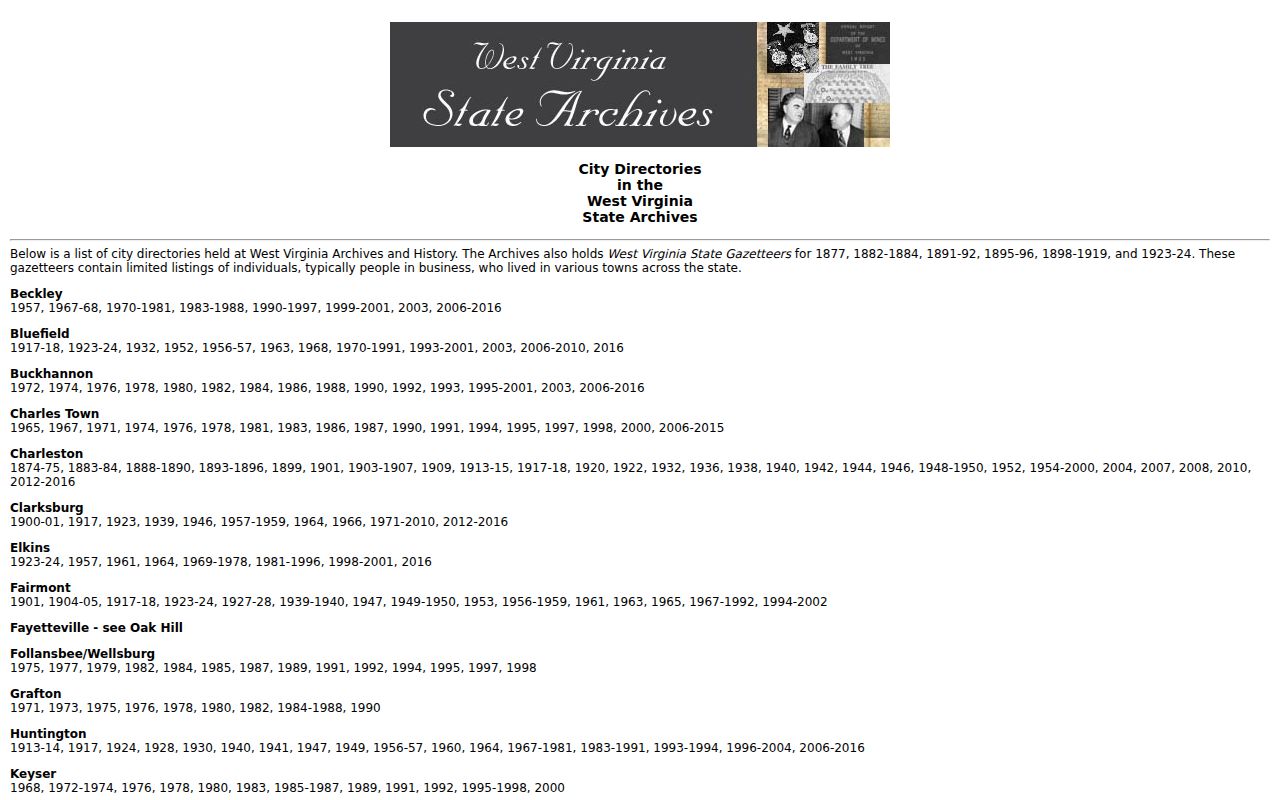
The missing-year problem changes the research method. Search the closest earlier and later volumes, note any address or trade change, then test that gap with newspapers, census schedules, deeds, maps, or municipal records. A person’s absence can mean a move, death, omission, name variation, or an unavailable book. It is not enough to choose one explanation.
Much older family research has another structural break. A 1796 courthouse fire destroyed early Monongalia marriage records from county formation through that year, though it did not erase every county series. For an early trail, use surviving land, will, tax, court, church, newspaper, or later derivative material. Never fill the missing marriage years with a guess.
Note: Record a negative result as “not found in the checked volume,” not as proof that the person was absent from Morgantown.
Search Morgantown Directories by Ward
The 1901 city directory groups streets through four ward descriptions: First, South Morgantown; Second, Greenmont and South Park; Third, Morgantown; and Fourth, Seneca and Wiles’ Addition. Its introductory matter also names Sunnyside and East Morgantown. Those labels belong to the volume’s period. They may not match a current ward, neighborhood boundary, postal city, or common local name.
Use each historical label as an alternate search term. A name missed in the general index may occur in a street list, institution section, business entry, or advertisement. Gale’s finding list also names Westover, Riverside, Randall, Mona, Woodburn, Jerome Park, Star City, and Sabraton in area directory reels. Search those community names separately before concluding that a person was not covered.
Morgantown’s Two-Stop History Desk
The Morgantown Public Library stands at 373 Spruce Street, and the Aull Center occupies the Garlow House next door. The house was built in 1907 for Aaron J. Garlow, who was linked to the Second National Bank. Aull was established in 2004 and holds books, photo albums, yearbooks, and family histories. Staff help is valuable when a city directory uses an old community name or when the right year is absent from the state list.
The library’s digital genealogy resources include Newspaper Archive, described as covering West Virginia papers from 1800 to the present, plus Ancestry Library Edition for in-library use. Newspaper notices, ads, social items, and obituaries can explain why a directory entry changes. Access is mixed: some work can begin online, subscription resources may require a library visit, and special local items may require staff guidance.
Extend Morgantown Directory Research at WVU
WVU’s West Virginia and Regional History Center genealogy guide supplies a second major access route. City directories sit in the 917.542-.5499 call-number area. Nearby research ranges include city and town histories at 975.411-.499, West Virginia biography at 920.0754, and birth, death, marriage, and cemetery material at 929.3. The center also has a personal-name card index covering 50 books and the state’s largest newspaper collection.
The guide below shows the institutional starting point for directories, county records, newspapers, and genealogy databases.
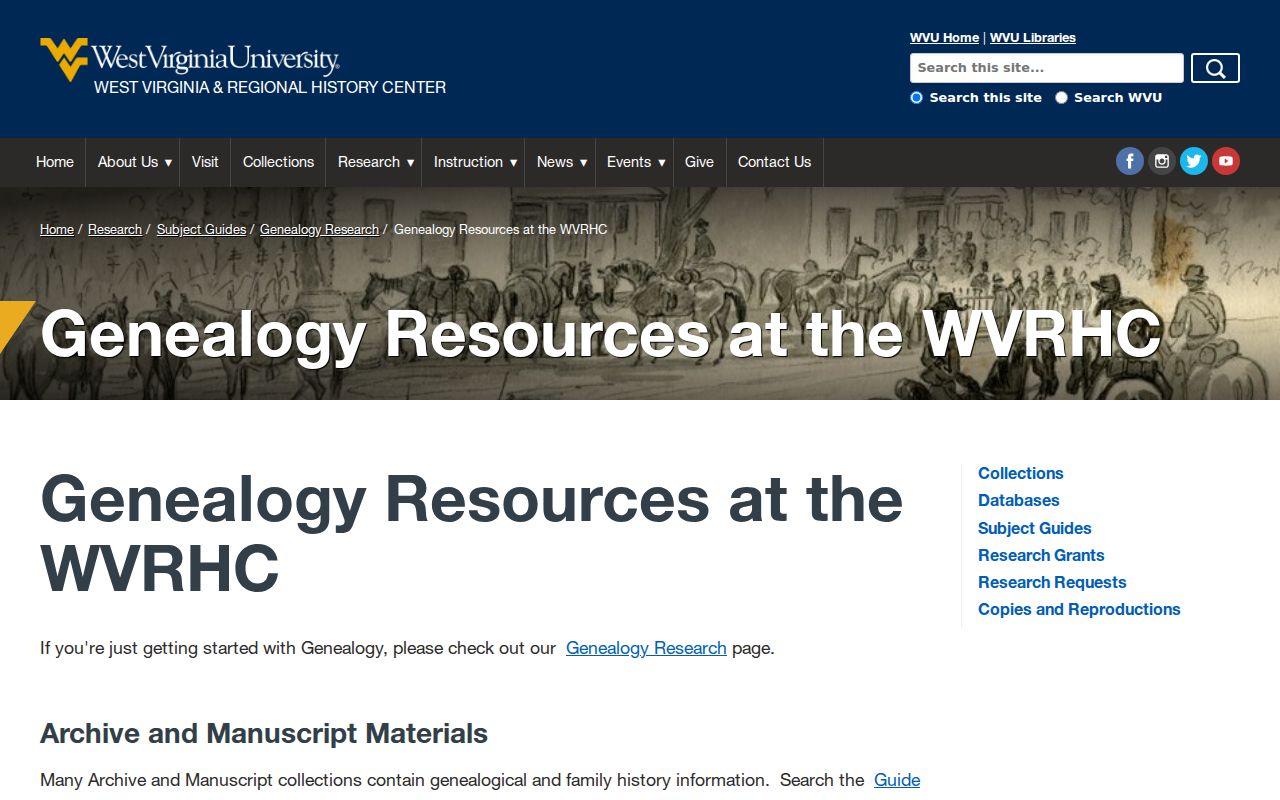
Non-WVU visitors may use center computers or seek a borrower card under library rules. Much newspaper content remains on microfilm even though selected papers appear in Chronicling America. For remote work, the WVRHC research-request route can confirm holdings or suggest the next collection.
Trace Family Through Morgantown Directories
A directory series fills some of the space between federal census years. It can show when a printed address, occupation, or community label changed. Build the trail one dated item at a time, and keep direct evidence separate from an inference.
- Choose the volume nearest the target date. Search the surname, street list, ward section, institutions, businesses, and general index.
- Move to the next available year in each direction. Copy the line exactly and note every gap in the holdings.
- Compare all people printed at the address, but label them as co-listed names until another source proves a relationship.
- Pair the directory line with the closest census year. Then test the address against a deed, tax map, newspaper, or vital record.
- If the name disappears, search obituaries, probate, newspapers, cemetery material, and nearby communities before deciding why.
Modern property work belongs in the Morgantown street directory. The city directory has a narrower purpose: show what a publisher printed for a certain year and provide leads that a second source can confirm.
Map Morgantown Directory Addresses
Sanborn fire-insurance maps add the building and block layer that a name list lacks. Documented Morgantown sets grow from one sheet in 1892 to six in 1899, ten in 1904, fifteen in 1906, twenty-seven in 1911, and forty in 1921. Later sets reach Westover, South Sabraton, Granville, Riverside, Star City, Sturgiss City, and other nearby places. A map can show street form and building footprint, not who lived there.
Compare the correct-year sheet with the directory’s street number and ward. Then consult WVU maps, atlases, and gazetteers for old names. Morgantown’s Old Stone House once stood on Long Alley, now Chestnut Street, a sharp reminder to keep both old and current street names in the notes.
Note: A map, directory entry, and deed answer different questions; agreement among them makes a historical address trail much stronger.