
Morgantown Address Sources Across Time
The available record changes with the year. Modern parcel records offer the fastest starting point, but Morgantown previous residents often appear in a dated directory, newspaper, or archival series rather than one continuous database. The table identifies verified spans without filling missing years by guesswork.
| Source | Years It Covers | Where Held | What It Shows |
|---|---|---|---|
| County recorded documents | Physical series; online cutoff not verified | Monongalia County Clerk | Indexed parties, transfers, book/page, instrument and legal description |
| Assessor maps and cards | Tax maps back to 1998 are listed | Monongalia County Assessor | Tax-year owner, parcel continuity, transfer notes and deed references |
| State Archives directories | Selected years, 1901 through 2002 | West Virginia State Archives | Names at addresses, work, business, street and ward clues |
| Monongalia county archives | 1776 through twentieth-century spans vary by series | West Virginia State Archives | Naturalization, vital, will and estate links |
| Sanborn maps | 1892 through 1921 listed set | Library of Congress | Street, block and building footprint, not named occupants |
For a late twentieth-century or newer question, start with the parcel and deed reference. For the early twentieth century, use a directory snapshot and map together. Earlier work depends more on deeds, wills, naturalizations, newspapers, and city records. The absence of previous residents in one volume means only that the names were not found in that source.
Save the Present Morgantown Parcel
Before looking for past residents, open the Monongalia County parcel search and save the exact physical address, district, map, parcel, root parcel ID when shown, current tax-year owner, and deed book/page. Also note whether the owner mailing address differs from the situs address. Situs means the property's physical location.
Then uncheck the control that returns current parcel information. That small switch is the key to the historical side of the assessor system. Review older transfer notes, dates, book/page references, and archived map context. Do not assume every historical card is a full chain. The office warns that assessment maps are not legal surveys and that its paper-card-derived data carries no warranty.
The statewide assessment search offers another Monongalia view with root parcel ID, current owner, property address, district/map/parcel, deeded acres, classification, and appraisal columns.
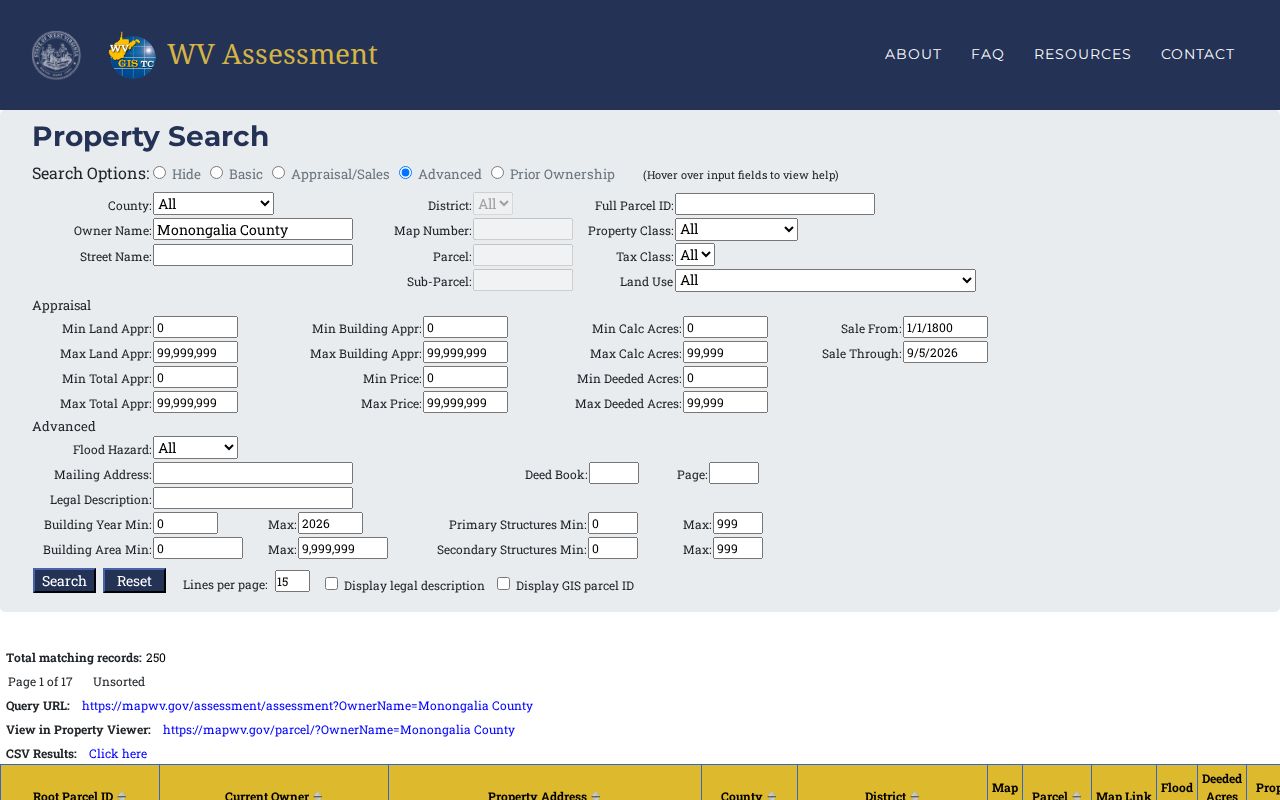
The screen helps preserve parcel identity before the trail moves backward. It is an assessment source, not proof of occupancy or legal title.
Walk Monongalia Deeds Backward
The deed chain is the strongest route for past ownership. A grantor gives or transfers an interest; a grantee receives it. Start with the current parcel card's citation and use the Monongalia County Clerk index. Official help supports personal and firm names, book/page, instrument number, part of a legal description, and recording dates.
- Copy the current owner, parcel identifiers, legal-description clue, and deed book/page from the assessor record.
- Find that purchase instrument in the Clerk index. Confirm indexed parties, document type, recording date, and image when available.
- Take the seller's name and search that party as a prior grantee. Use a narrow date range around the likely purchase.
- Repeat the link. Record trusts, estates, businesses, mineral interests, and parcel splits as such instead of treating them as residents.
- When the web trail ends, use the Clerk's public computer, request copies, or inspect the physical book. No official online cutoff year was found.
- Grantor and grantee
- The party transferring an interest and the party receiving it.
- Chain of title
- The linked series of recorded interests and transfers for one property.
- Legal description
- The deed's land description, often more stable than a street number.
- Instrument number
- A filing identifier used to retrieve an indexed document.
A deed proves a recorded transaction, not that the grantee lived in the Morgantown house. Add a dated directory, census, newspaper, or other household source before naming previous residents.
Check Morgantown Tax Tickets
The Monongalia Sheriff tax inquiry can corroborate a previous residents trail with taxpayer name, account, ticket, tax year, district, map, parcel, and subparcel. Use it after the assessor and before declaring a gap. A tax ticket is evidence that a named party was tied to the tax account for a stated year.
It is not a deed, and it does not show who slept at the address. If the taxpayer changes near a recorded transfer, note the timing and retrieve the deed. If the taxpayer stays the same while a directory name changes, keep both facts. They may describe ownership and occupancy separately.
Pair Morgantown Directory Snapshots
Morgantown city directories work as year-stamped address snapshots. The State Archives lists 1901, 1904-05, 1917-18, 1923-24, 1927-28, 1939-40, and many later volumes through 2002, with visible gaps. The full 1901 directory was revised through April 8 and can be browsed by name, street, ward, institution, or business.
- Choose the directory year nearest the deed transfer or target date.
- Search both the surname section and street or ward material. Copy the entry exactly.
- Check the next available volume on each side of the date. Do not invent continuity across a missing year.
- Pair the address listing with the nearest available federal census, then compare names, ages, and household order.
- Use newspapers, deeds, and probate to explain a move, death, inheritance, or sale.
The historical collections and publishers are treated in depth on the Morgantown city directory page. For previous residents research, the key is how one exact address changes from volume to volume.
Catch Morgantown Street Name Breaks
The Old Stone House once stood on Long Alley, which is now Chestnut Street. That documented change shows why a modern address can disappear from an older index. Search the former and present names, plus Street/St., Avenue/Ave., Lane/Alley, directions, and old ward or community labels.
Historical Morgantown entries may use Greenmont, South Park, Seneca, Wiles' Addition, Sunnyside, or South Morgantown as place context. Keep the old wording beside a modern map approximation. Do not silently convert it. The source's own label can be what makes a directory or newspaper search work.
Map an Earlier Morgantown House
Sanborn fire-insurance sheets add the building layer to a previous-residents trail. The listed Morgantown series expands from one sheet in 1892 to six in 1899, ten in 1904, fifteen in 1906, twenty-seven in 1911, and forty in 1921. The later maps include places such as Westover, South Sabraton, Granville, Riverside, Star City, and Sturgiss City.
Compare the lot, street, alley, footprint, and neighboring structures with a deed or directory year. A matching footprint can support address continuity, but the map does not name a household. The 1899 sheet is available through the Library of Congress Morgantown Sanborn set.
Ask Morgantown History Collections
When the online trail stops, use the local research network. The Aull Center sits beside the main Morgantown Public Library in the 1907 Garlow House and holds local books, photographs, yearbooks, and family histories. The library's Newspaper Archive describes West Virginia paper coverage from 1800 to the present, while Ancestry Library Edition is available only inside the library.
WVU's West Virginia and Regional History Center holds directories, county records, maps, and the state's largest newspaper collection, much of it on microfilm. Its research-request route is the documented remote option for holdings advice. No dedicated online Morgantown house-history guide or separately named obituary index was located, so ask staff about clipping files, card indexes, or an unpublished source instead of assuming one exists.
The research-request page shows the route available to people who cannot begin onsite.
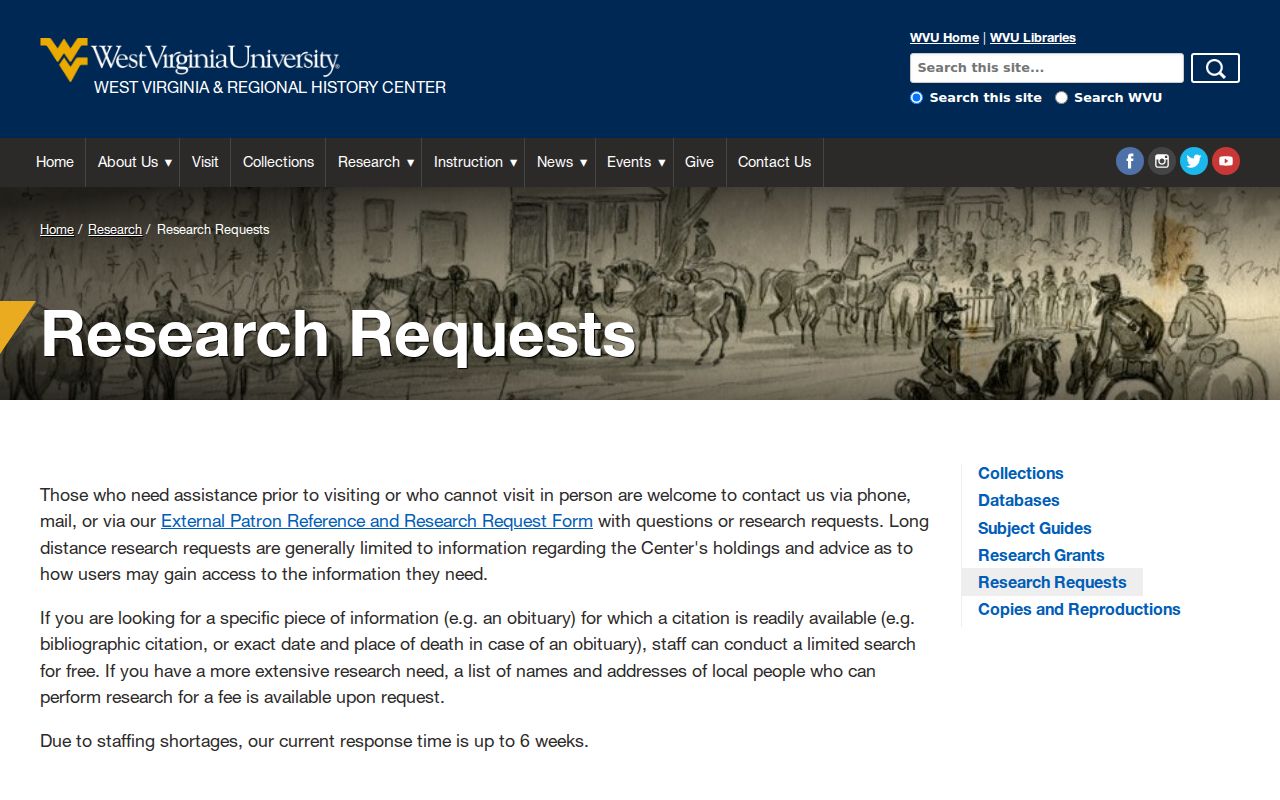
A specific request should include the exact address, variant street names, an approximate year, and the records already checked.
Respect Morgantown Record Gaps
A courthouse fire in 1796 destroyed Monongalia marriage records from county formation through that year, but it did not erase every early county record. State Archives still lists naturalizations beginning in 1776 and later wills, vital material, and marriages. For Morgantown previous residents, treat the fire as a precise gap, not a reason to abandon all eighteenth-century research.
Directory gaps are also holding gaps, not proof that no one occupied an address. The deed portal's first online year was not found. Live portals sit above older books, cards, microfilm, and clerk files. Record each missing year and failed search in the house ledger, then move to the next source or custodian.
Note: A blank index result means the searched system produced no hit; it does not prove that no earlier record survives.
Confirm Morgantown Previous Residents
Ownership is only half of a house history. A directory entry can place a named person at an address in a named year, and a census may show a household group. Newspapers can add a move, social notice, sale, or obituary. Shared address alone does not prove family ties, and an occupation in a directory is not proof of title.
Probate can explain why an owner changes to an estate or heir. Monongalia wills are listed for 1819-1957 at the State Archives, while the County Clerk handles local fiduciary files and appointments. Naturalization, death, marriage, and cemetery evidence may distinguish people with the same name. Cite the event record and date rather than copying protected personal fields.
A reliable conclusion uses careful labels: recorded owner, taxpayer, listed resident, census household member, or person named in a notice. Those terms preserve what each source truly establishes and make conflicts easier to resolve.
Lawful use. Research Morgantown past residents for house history, family history, and lawful personal curiosity. Never use a record to track, harass, threaten, or harm a living person.